A heatwave used to mean checking the forecast. Now it can mean checking the building.
Can the classroom stay open? Can the bedroom cool down at night? Can the hospital ward keep people safe? Can the train run without slowing? Those sound like infrastructure questions, but families meet them as ordinary life. The room is too hot. The school message arrives. The trip takes longer. The fan is already sold out.
That is why the current heat story belongs on The Fast Now. The weather is not only outside anymore. It is testing the buildings, schedules, power systems, care systems, and habits people assumed would keep working.
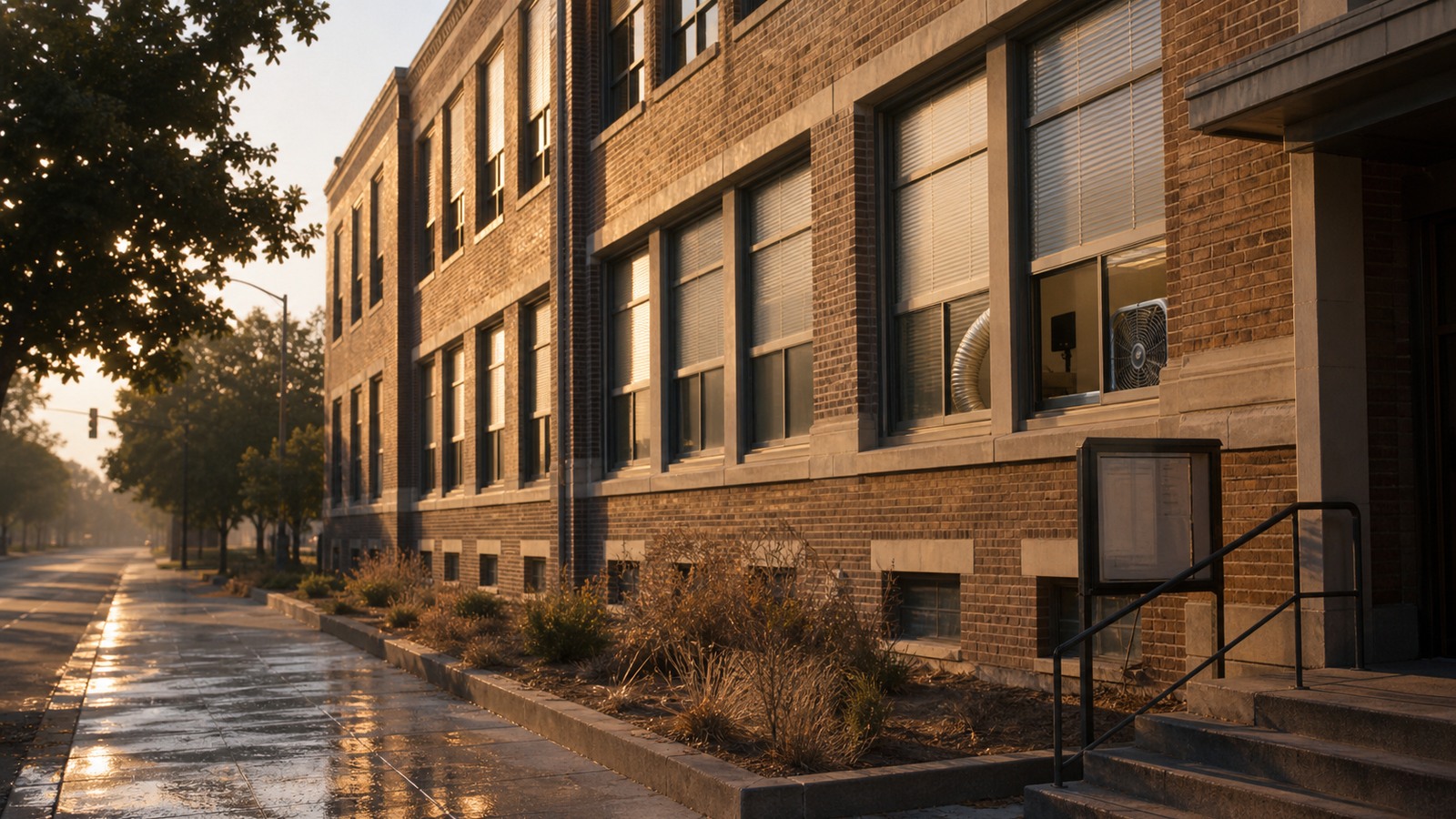
BBC News reported that Wales recorded its hottest June day, with more than 840 schools closed during the heat. One Cardiff head teacher said small classrooms with limited-opening windows overheat very quickly once 30 pupils are inside. A Swansea University researcher put the point even more directly: the infrastructure of schools is not equipped for the extreme temperatures.
That sentence is the story. Closing a school may be the right short-term safety call, but it also shows that the building has become part of the weather emergency. Parents have to rearrange work. Children lose another day. Staff are asked to manage rooms designed for a cooler climate.
The same test shows up at home. Al Jazeera reported on a London pharmacist caring for an unwell five-month-old grandson in a room he could not cool. At midnight, he said, his home was 31 degrees. The official warning was not enough. The practical question was whether the room could be made safe in time.
Air conditioning is part of the answer, but it is not the whole answer. Cooling has to be planned like public infrastructure, not treated like a luxury gadget people buy after the heat arrives. Shade matters. Insulation matters. Ventilation matters. Heat pumps and efficient equipment matter. So do trees, cool spaces, emergency plans, and a power grid that can handle the load when everyone tries to cool down at once.
This is what adaptation looks like before it gets a slogan. It looks like a school checking whether the windows open. A hospital checking which wards overheat first. A transit agency checking where rails and signals fail. A family checking whether an elderly neighbor has a cool room and someone to call.
World Weather Attribution notes that heatwaves are among Europe’s deadliest hazards and that risk is shaped by age, chronic illness, access to cooling, housing quality, and socioeconomic conditions. That means heat is not only a temperature number. It is a fairness test, a maintenance test, and a design test.
The phrase “building code” sounds technical. But the plain version is simple: can the places we live, learn, travel, and recover in still protect us when the weather changes faster than the building stock?
The next heatwave will arrive as a forecast. The real warning will be inside the rooms.
What to watch
- Which schools close because rooms cannot be kept safe, and which retrofit before the next heatwave?
- Do public-health warnings include practical cooling access, or only advice to stay hydrated?
- Can hospitals, care homes, and transit systems name their hottest failure points before they fail?
- Does cooling demand get planned with the power grid, or treated as a private household problem?
- Do local building standards begin treating heat resilience as basic habitability?
Source note
Sources include BBC News reporting on Welsh school closures and rail restrictions during record June heat, Al Jazeera reporting on UK homes, schools, transport, and emergency services under extreme heat, and World Weather Attribution analysis of the European heatwave and heat-health risk.
- BBC News: Wales hottest June day and school closures: Record June heat in Wales, more than 840 school closures, rail restrictions, and public comments on school-building heat limits.
- Al Jazeera: UK heat preparedness: Household heat, school closures, transport disruption, ambulance surge staffing, and warnings about practical preparedness.
- World Weather Attribution: European heatwaves: Heatwave attribution, health risk, infrastructure stress, and the need for heat-health preparedness.