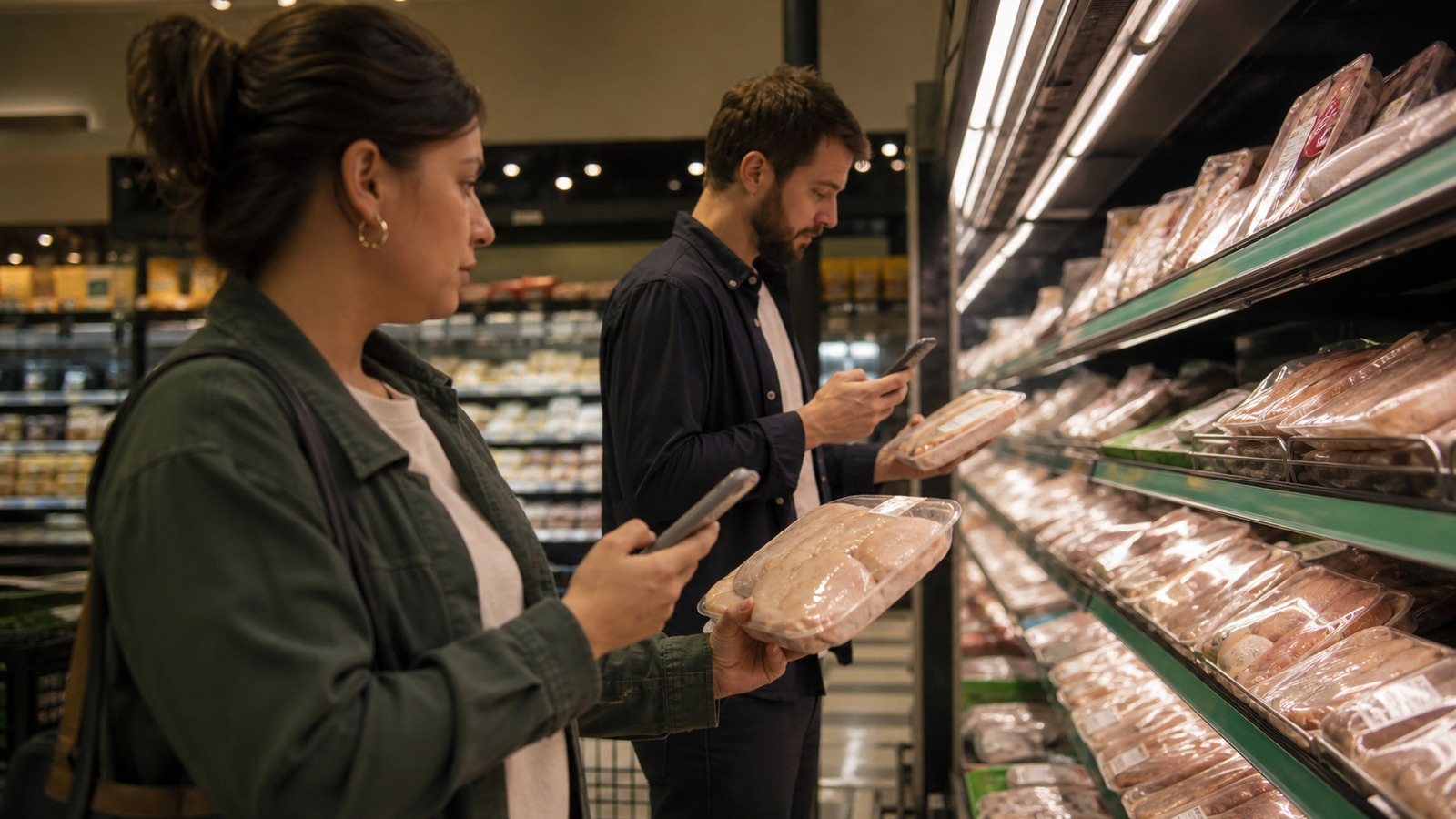
Picture a Tuesday afternoon at a Safeway. You open the app to check the rotisserie chicken. You see $8.99. Someone two blocks away opens the same app, same store, same chicken, and sees $7.79. Neither of you knows the other exists.
That scene is no longer only a hunch. A Senate Judiciary subcommittee held a hearing on August 4, 2026, titled “Your Data, Their Profit: The Consumer Cost of AI Surveillance Pricing.” It was not a vote. No federal law came out of the room. The hearing put a public date on something already showing up in ordinary shopping.
Three kinds of price difference get mixed together. They should not.
The first is a plain discount. You have a coupon, a loyalty card, or a membership. The seller knows it. You know it. The gap is disclosed. This is old.
The second is time or demand. Airlines have done this for decades. A seat costs more Friday afternoon than Tuesday morning. Grocery stores have timed markdowns on perishables since before the internet. The price changes, and it changes for everyone in that moment.
The third uses personal data about a specific shopper, assembled from browsing, location, purchase history, or demographic inferences, to set a number for that person. That is the practice the Senate hearing was examining. Researchers and regulators have started calling it surveillance pricing.
Keep those three kinds of difference in mind. The public documents mix them unless you hold them apart.
In July 2024, the Federal Trade Commission sent 6(b) orders, compulsory information requests, to eight firms: Mastercard, Revionics, Bloomreach, JPMorgan Chase, Task Software, PROS, Accenture, and McKinsey. These are intermediaries that help retailers analyze data and set prices, not the grocers themselves. By January 2025, FTC staff had reviewed productions from six of those eight and published research summaries.
The staff document is careful. It does not assess whether any conduct was illegal. Staff views are not necessarily the Commission’s. With that on the table, the summaries still describe a picture worth reading. Multiple respondents reported revenue growth of 2 to 5 percent and margin increases of 1 to 4 percent from personalized pricing practices. The intermediaries collectively worked with at least 250 clients, from grocery to apparel. Then-Chair Lina M. Khan said Americans deserve to know how private data is used to set the prices they pay.
In September 2025, Groundwork Collaborative, Consumer Reports, and More Perfect Union ran a field test. They enrolled 437 shoppers across four cities and had them build matching baskets on Instacart at Target and Safeway. The published results found that 74 percent of items were offered at multiple price points depending on which shopper’s account was used. For those items, the average spread was 13 percent. Some items ran 23 percent higher for one shopper than another. Basket totals sat about 7 percent apart.
The researchers also used Instacart’s household spend estimate to project that a gap of that size could reach about $1,200 a year for some households. That figure is an extrapolation, not a measured annual loss. The tests stopped short of purchase, so the number on the screen may not be the number at checkout in every case.
What the tests establish is narrower and still useful. Different accounts, shopping for the same item at the same store at roughly the same time, were shown different numbers. The tests do not isolate which input produced each difference: account history, device, location, or something else. Displayed-price variation is documented. The exact cause, in any one case, is not.
While the software side draws the hearing, a hardware change is happening on the shelf. On March 2, 2026, Walmart said about 2,300 of its U.S. stores were already using digital shelf labels, with a chain-wide rollout expected within the next year. The labels let a store rewrite the number without swapping a paper tag.
The company was direct about what it says those labels do not do: “It’s important to remember that prices are the same for all customers in any given store and are consistent regardless of demand, time of day or who is shopping.”
Walmart also said the updates are people-led and that the labels do not collect shopper information. Digital shelf labels change how fast a store can rewrite a number. They do not automatically mean the shopper beside you is seeing a different one.
One state has started writing rules. New Jersey’s Fair Price Protection Act, A4085/A4523, was approved July 23, 2026, as P.L.2026, c.55. It makes it unlawful for grocery sellers to vary food prices based in whole or in part on a customer’s personal data. The law leaves room for disclosed group discounts, qualifying loyalty programs, and limited cost-based differences. The core prohibition takes effect August 1, 2027, the first day of the thirteenth month after enactment. It is not governing checkout today.
New Jersey is one state. The Senate hearing was an inquiry, not legislation. No federal rule has passed.
Not everyone reading the same record reaches the same conclusion. Z. John Zhang, a marketing professor at the Wharton School, submitted written testimony on August 4, 2026: “In my view, the term \"surveillance pricing\" is a misleading label for personalized pricing.”
Zhang’s position, shared by some economists, is that personalized pricing can, if competition holds, expand access for price-sensitive buyers. The label, in that view, frames the tool as extraction before the evidence has settled the question. That disagreement belongs in the record.
What this evidence cannot establish
The public record does not prove that any specific retailer charged you more because of your personal data. It does not establish that the Instacart displayed-price gaps were caused by personal-data targeting rather than other variables. It does not mean digital shelf labels are showing you a different number than the shopper beside you. And it does not mean the FTC found illegal conduct. The staff document says it does not make that assessment.
Write down two numbers
Pick one item you buy often. Write down the number on the shelf or product page. Write down the number that appears after login, location, or loyalty. If they differ, ask the seller what explains the gap.
That question, put to a specific seller about a specific item, is more useful than a general alarm. The answer, or the lack of one, is the observation. It is not a promise that a second account or a private window will produce a lower price.
Public sources
- FTC 6(b) Surveillance Pricing Study Research Summaries (redacted, Jan 2025)
- FTC press release, January 2025
- Senate Judiciary hearing, August 4, 2026
- Z. John Zhang written testimony, August 4, 2026
- New Jersey A4085, Fair Price Protection Act
- Walmart, March 2, 2026
- Groundwork / Consumer Reports / More Perfect Union Instacart tests