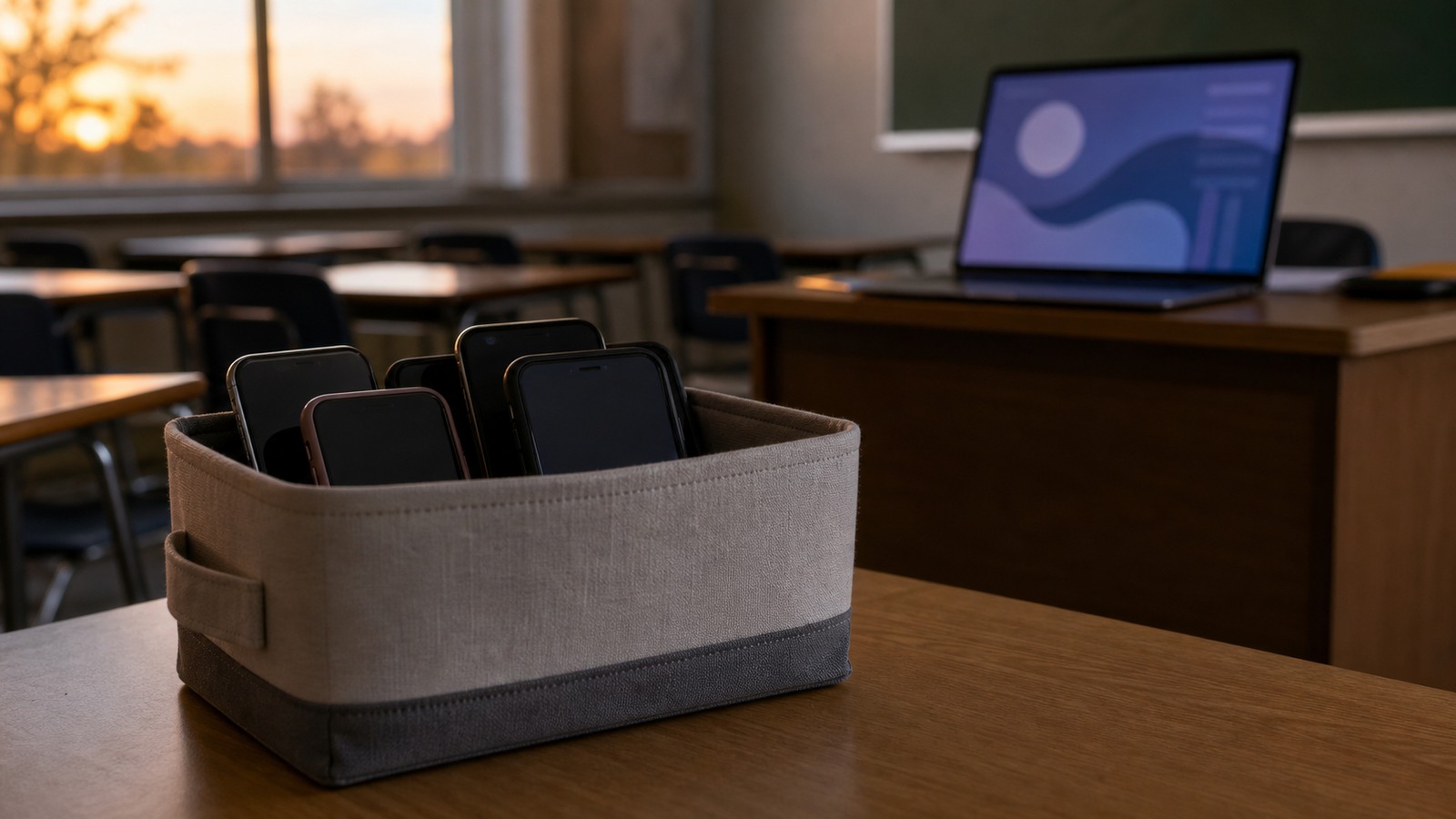
Schools are finally naming one obvious problem: the phone is too powerful to be treated like a pencil.
New York’s phone-free schools law now requires bell-to-bell restrictions on smartphones and other internet-enabled personal devices in K–12 schools. California law requires districts and charter schools to adopt policies limiting or prohibiting smartphone use by July 1, 2026. The local details differ, but the public signal is clear. Classrooms are trying to recover attention.
At the same time, another machine is entering the building.
In an April 13, 2026 Federal Register notice, the U.S. Department of Education finalized a supplemental priority on advancing AI in education. It can be used in discretionary grant programs and names AI literacy, teacher training, tutoring, advising, instructional resources, and administrative efficiency as possible funding themes. New York City Public Schools has already published AI guidance saying any AI tool that touches student or staff data must go through ERMA, its privacy and security review process. NYCPS also says vendors must disclose AI capabilities, student data cannot be used to train AI models, and human review of AI outputs is required.
That is the real story. Schools are not simply becoming anti-technology. They are deciding which systems are allowed to mediate student attention.
A phone ban is visible. It has pouches, lockers, parent objections, enforcement questions, and hallway habits. AI adoption is quieter. It arrives as tutoring, translation, lesson support, grading help, procurement language, grant language, dashboards, and efficiency. One machine is treated as a distraction. The other is treated as infrastructure.
That is why Rebekah Fant-Male of Laine Education is useful here. In comments shared with The Fast Now, she made the school-market contradiction plain: “the barrier to entry of EdTech/AI products for schools will become higher than before, despite lower threshold to build EdTech.” Her prediction is not that schools will suddenly reject all technology. It is that market access gets harder as schools become more resistant to AI hype marketing, screen-time pressure, security and privacy risk, and the lack of educational-impact evidence.
Her practical lever is simple and demanding: “develop an evidence mindset.” Build with school professionals, understand their contexts, stay close to the needs the product is actually well-placed to solve, and ground decisions in internal and external evidence. She also drew a sharper line between making AI in education sound less like hype and making sure it is not hype in the first place. In education, that distinction matters.
The practical question for parents and teachers is not whether AI is good or bad. It is much more specific: what is this tool allowed to mediate?
Is it helping a student practice, or replacing the struggle that proves learning happened? Is it helping a teacher prepare, or making the teacher inspect more invisible work? Does it touch student data? Can families understand it? Can a teacher override it? What evidence would make the school pause or remove it?
Phones taught schools the cost of ungoverned attention. AI will test whether they learned the right lesson.
A school can take the phone out of a student’s hand and still let a more complicated system sit between the student and learning. The next classroom policy should say more than which devices are banned. It should say which machines are trusted, what they are allowed to do, what proof they must carry, and who can turn them off.
What to watch
- Do districts treat AI approval as a living review process or a one-time procurement checkbox?
- Can families see what student data a school-approved AI tool touches?
- Do schools require evidence of educational impact before adoption, or only privacy/security paperwork?
- Can teachers override, pause, or remove AI systems that make classroom work harder to trust?
- Do phone-ban policies and AI-adoption policies talk to each other, or move in separate lanes?
Source note
Sources include NYC Public Schools AI guidance, New York’s phone-free schools law, the U.S. Department of Education’s April 2026 AI-in-education priority, California’s school smartphone policy statute, and comments shared with The Fast Now by Rebekah Fant-Male of Laine Education.
- NYC Public Schools AI guidance: District guidance on AI tools, ERMA review, student/staff data, vendor disclosure, and human review.
- New York State phone-free schools law: Bell-to-bell restrictions on smartphones and other internet-enabled personal devices in K–12 schools.
- U.S. Department of Education Federal Register priority: Final supplemental priority on advancing AI in education for discretionary grant programs.
- California Education Code 48901.7: Deadline and scope for school smartphone-use policies.
- Laine Education presentation: Public context for Rebekah Fant-Male’s education technology and evidence work.